
Table of Contents
- Bland AI fixed Retell pricing. Here is the trade-off.
- What Bland AI actually costs in 2026
- Three pricing models, side by side
- SuperMIA pricing: one credit pool for voice or chat
- Monthly cost at 3 call volumes
- Feature coverage comparison
- Head-to-head comparison table
- Who should pick Bland vs SuperMIA
- The short version
Quick Answer
Bland AI runs $299–$499/mo plus $0.11–$0.14/min — no minutes included in the subscription. At 10,000 minutes, real cost lands near $1,599/mo. SuperMIA bundles voice + chat on one credit pool at $0.10–$0.12/min effective — cheaper above ~8K minutes and adds chat that Bland doesn't offer.
Bland AI fixed the Retell pricing problem. Here is what it cost them.
If you have compared voice agent vendors in 2026, you have seen how often pricing explodes after launch. Bland AI made a cleaner bet: subscription tiers that unlock lower per-minute rates. Build starts at $299/month with $0.12/min. Scale is $499/month with $0.11/min. That is simpler than modular billing.
The trade-off is important: the monthly subscription does not include minutes. You pay for the plan, then you pay usage on top. SuperMIA uses a different model: one credit pool that converts to voice or chat from the same plan, with telephony, analytics, and compliance bundled.
This guide compares both models at real operating volumes: 1,000, 10,000, and 100,000 monthly minutes. We include where Bland wins, where SuperMIA wins, and which buyer profile each platform fits best.
TL;DR
- Bland AI uses subscription plus usage: Start (free, $0.14/min), Build ($299/mo, $0.12/min), Scale ($499/mo, $0.11/min). Paid plans do not include minutes.
- SuperMIA uses an all-inclusive credit model: plans include voice minutes and chat conversations from one shared pool.
- At 1,000 min/mo, SuperMIA is much cheaper because Bland's subscription fee is amortized over low volume.
- At 10,000 min/mo, SuperMIA remains cheaper in this benchmark and also includes chat workflows.
- At 100,000 min/mo voice-only, Bland can be cheaper if enterprise per-minute rates are negotiated aggressively.
What does Bland AI actually cost in 2026?
Bland AI's current structure is straightforward: the more monthly subscription you commit to, the lower your minute rate. Start is free at $0.14/min, Build is $299/month at $0.12/min, Scale is $499/month at $0.11/min, and Enterprise is custom.
The key mechanic to model correctly is this: the plan fee does not include call minutes. Effective cost per minute depends on your total usage and rises quickly at low volume.
Where Bland is genuinely strong
- Predictable voice-side billing compared with modular vendor stacks.
- Developer-first API architecture and high implementation control.
- BYOT options for teams with existing telephony contracts.
- Strong suitability for high-scale voice-only workloads.
Three pricing models, side by side
This chart shows why buyers compare these vendors together: pricing model fit matters as much as headline rate.
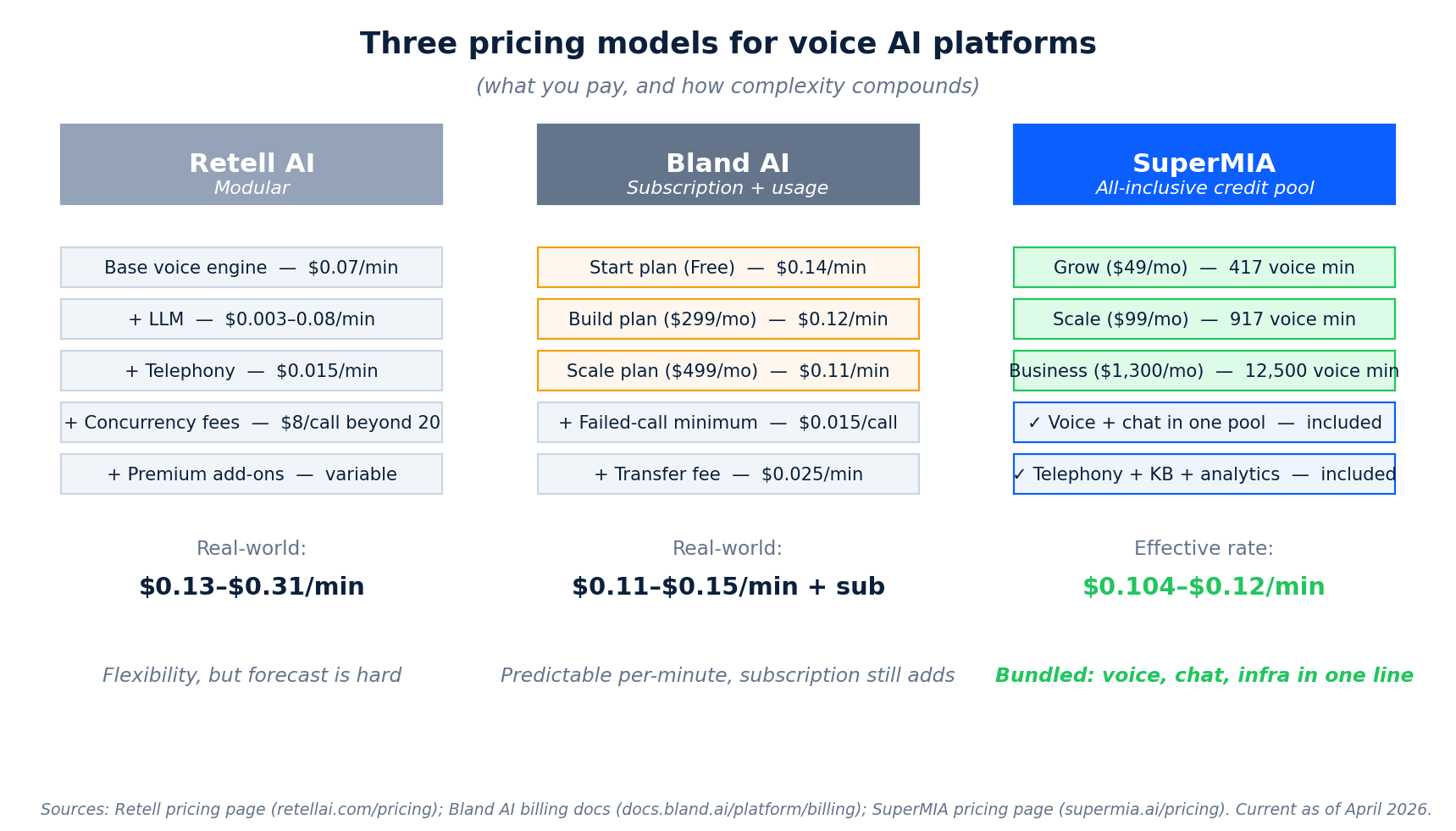
Reference links: Retell pricing and Bland billing docs.
The hidden costs nobody puts on the pricing page
The advertised tier is never the invoice. Three line items decide what Bland actually costs in production, and none of them show up on the pricing page until you are already deployed.
Concurrency
Bland's per-minute rate assumes serial calls. The moment your call volume spikes — a campaign send, a Monday-morning queue, an outage notification — you pay for concurrent capacity. Budget for peak concurrency, not average minutes, or your effective per-minute cost climbs 20–40% above the quoted rate. A team running 10,000 minutes per month with an average 8 concurrent calls during peak hours is paying a meaningfully different effective rate than the pricing page suggests.
Telephony passthrough
Carrier minutes are billed separately from the AI layer on most usage-based voice platforms. At scale this is a real line item, not a rounding error. For US domestic calls, expect $0.01–$0.03/min carrier passthrough on top of the AI rate. At 10,000 minutes that is $100–$300 per month that never appears in the headline comparison. Model it explicitly before you compare rates across vendors.
Premium voices and add-ons
The natural-sounding voices most teams actually ship with sit in a premium tier. The base rate quotes the cheapest voice; the voice you demo and approve usually is not it. Premium voice uplift can add $0.01–$0.03/min depending on the provider and model. Multiply across your monthly volume and it is material.
SuperMIA's pricing folds voice, chat, telephony, and analytics into one credit pool, so the number you model is the number you pay. That predictability is the point — not a discount gimmick, a budgeting one. No concurrency surcharges, no carrier passthrough line items, no premium voice tiers. One credit, one price, one invoice.
SuperMIA pricing: credits that work for voice or chat
SuperMIA uses one credit pool across channels. Every plan includes both voice and chat capacity, and overage is priced by credits rather than splitting billing logic by channel.
| Plan | Monthly | Voice Minutes | Chat Capacity | Effective $/min |
|---|---|---|---|---|
| Launch | $10 | 84 | 500 | $0.12 |
| Grow | $49 | 417 | 2.5K | $0.12 |
| Scale | $99 | 917 | 5.5K | $0.108 |
| Business | $1,300 | 12,500 | 75K | $0.104 |
| Enterprise | Custom | Custom | Custom | <$0.10 (estimated) |
Current plan details: supermia.ai/pricing.
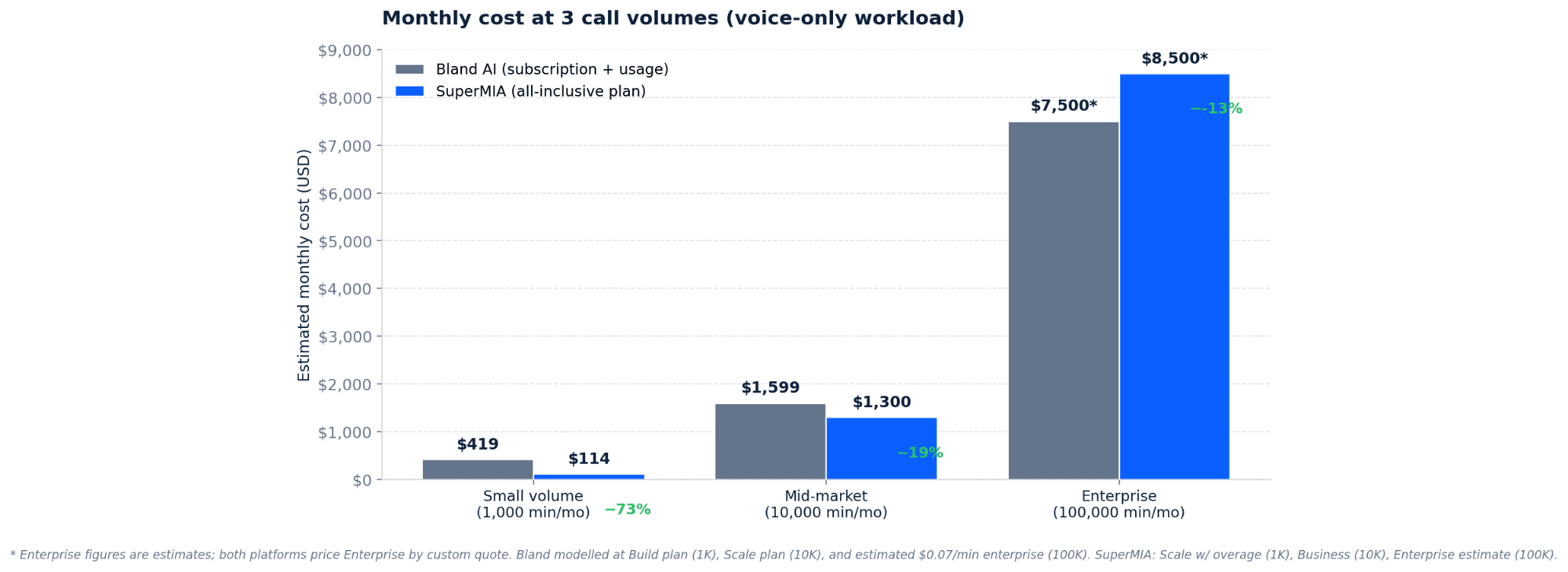
Monthly cost at 3 call volumes (honest math)
Scenario 1: 1,000 min/month
Bland Build: $299 platform fee + (1,000 × $0.12/min) = $419/month base. Add estimated carrier passthrough ($10–$30) and premium voice uplift ($10–$30) — realistic total: $439–$479/month. Effective cost per minute: $0.44–$0.48.
SuperMIA Scale: $99/month plan includes 917 voice minutes. The 83-minute overage costs roughly $9–$10 in credits. Realistic total: ~$108–$109/month. Effective cost per minute: ~$0.11.
At low volume, the subscription-fee effect is massive. Bland's $299 platform fee amortized over only 1,000 minutes adds $0.30/min to the effective rate before any hidden costs hit. This is the volume range where credit-based bundled models dominate.
Scenario 2: 10,000 min/month
Bland Scale: $499 platform fee + (10,000 × $0.11/min) = $1,599/month base. Add carrier passthrough ($100–$300) and premium voice ($100–$300) — realistic total: $1,799–$2,199/month, voice only. Effective cost per minute: $0.18–$0.22.
SuperMIA Business: $1,300/month with 12,500 voice minutes and 75K chat conversations included. No overages at this volume. No carrier passthrough. No premium voice tiers. Effective cost per minute: $0.104 — and chat is already in the number.
At mid-market volume the math shifts from platform-fee amortization to total-cost-of-ownership. The $499–$899/month delta funds the chat channel you would otherwise buy separately on Bland's stack.
Scenario 3: 100,000 min/month (voice-only)
Bland Enterprise: Custom pricing — published rates stop at Scale. At this volume, enterprise teams negotiate per-minute rates in the $0.07–$0.09/min range (estimated). Platform fee is typically waived or bundled. Carrier passthrough and premium voice still apply but are negotiated as package rates. Estimated total: $8,000–$12,000/month depending on contract terms.
SuperMIA Enterprise: Custom pricing. Estimated effective rate below $0.10/min with included chat capacity. Volume commitments drive discounts. Estimated total: $9,000–$11,000/month including both voice and chat.
At enterprise volume, Bland can be cheaper for pure voice-only workloads if your negotiated rate hits the low end of the range and you genuinely need zero chat capacity. If you also need high-volume chat, the comparison flips — because Bland does not offer chat, meaning you are adding a second vendor, a second contract, and a second billing model on top of whatever voice rate you negotiated. The total vendor stack cost matters more than any single line item at this scale.
Model your exact call volume before choosing
Get side-by-side cost modeling for your workload profile.
Get Custom Pricing →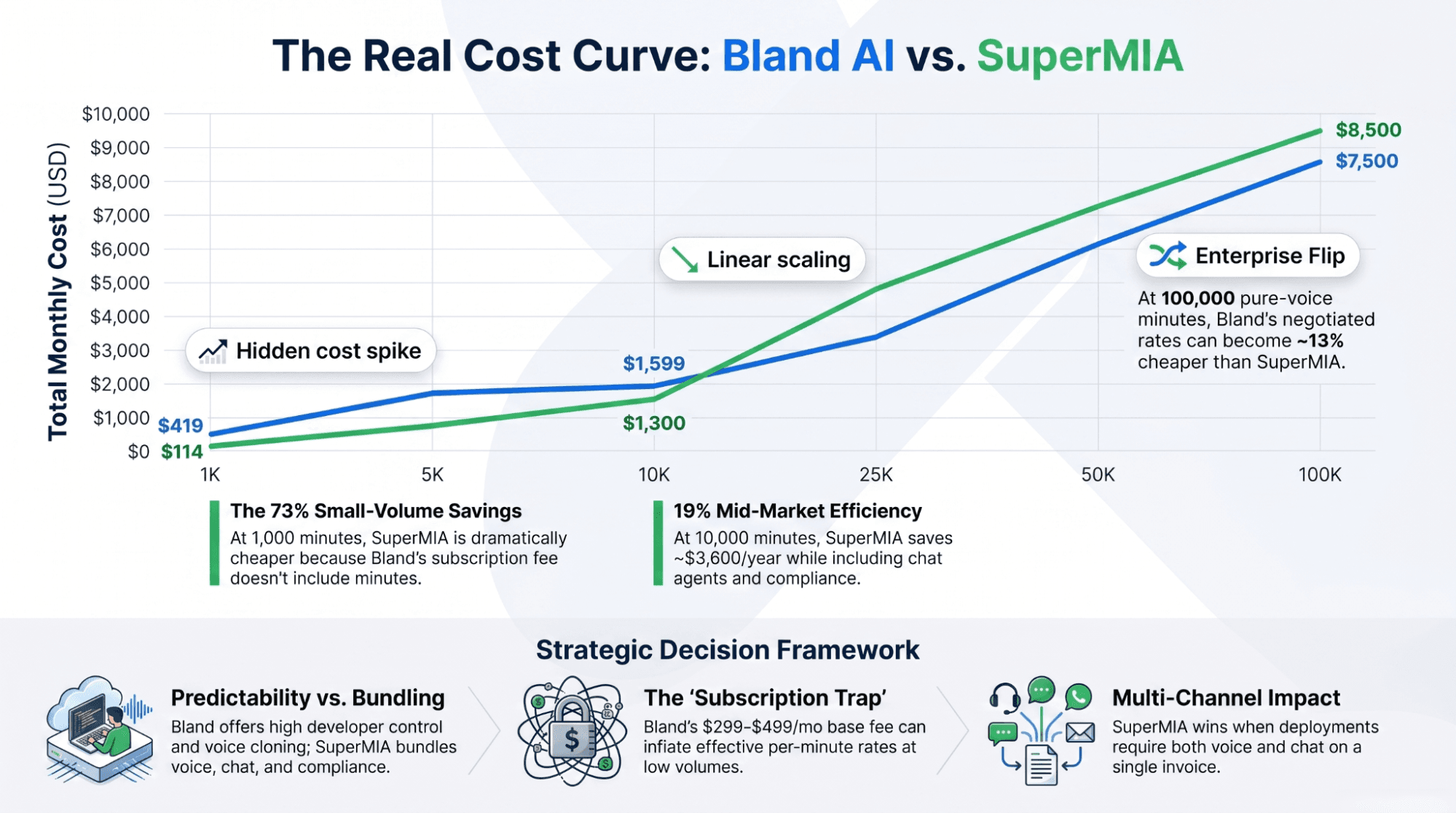
A realistic mid-market deployment (illustrative)
Picture a 40-seat support team fielding roughly 10,000 voice minutes a month, with a chat channel they want to add next quarter. On Bland, that team pays the platform tier ($499/mo for Scale) plus per-minute voice (10,000 × $0.11 = $1,100) plus carrier passthrough ($100–$300 estimated) plus a premium voice uplift ($100–$300 estimated) — and chat is a separate procurement entirely. Total voice-only estimate: $1,799–$2,099/month before chat.
On SuperMIA, the same 10,000 minutes plus the chat channel draw from a single credit pool on the Business tier: $1,300/month, one invoice, one vendor to manage. The chat channel that would be a second vendor on Bland's stack is already included. No carrier passthrough surprise, no premium voice uplift, no concurrency penalty during Monday-morning spikes.
The headline per-minute rates look close ($0.11 vs $0.104 effective). The total cost of ownership does not — because the second platform you would otherwise buy for chat is already included, and the line items that surprise finance teams (concurrency, passthrough, premium voice) are already in the number. At this volume, the delta is $499–$799/month in favor of the bundled model, and that gap widens once you factor the ops cost of managing two vendor contracts, two billing models, and two support escalation paths.
Feature coverage: where each platform invests
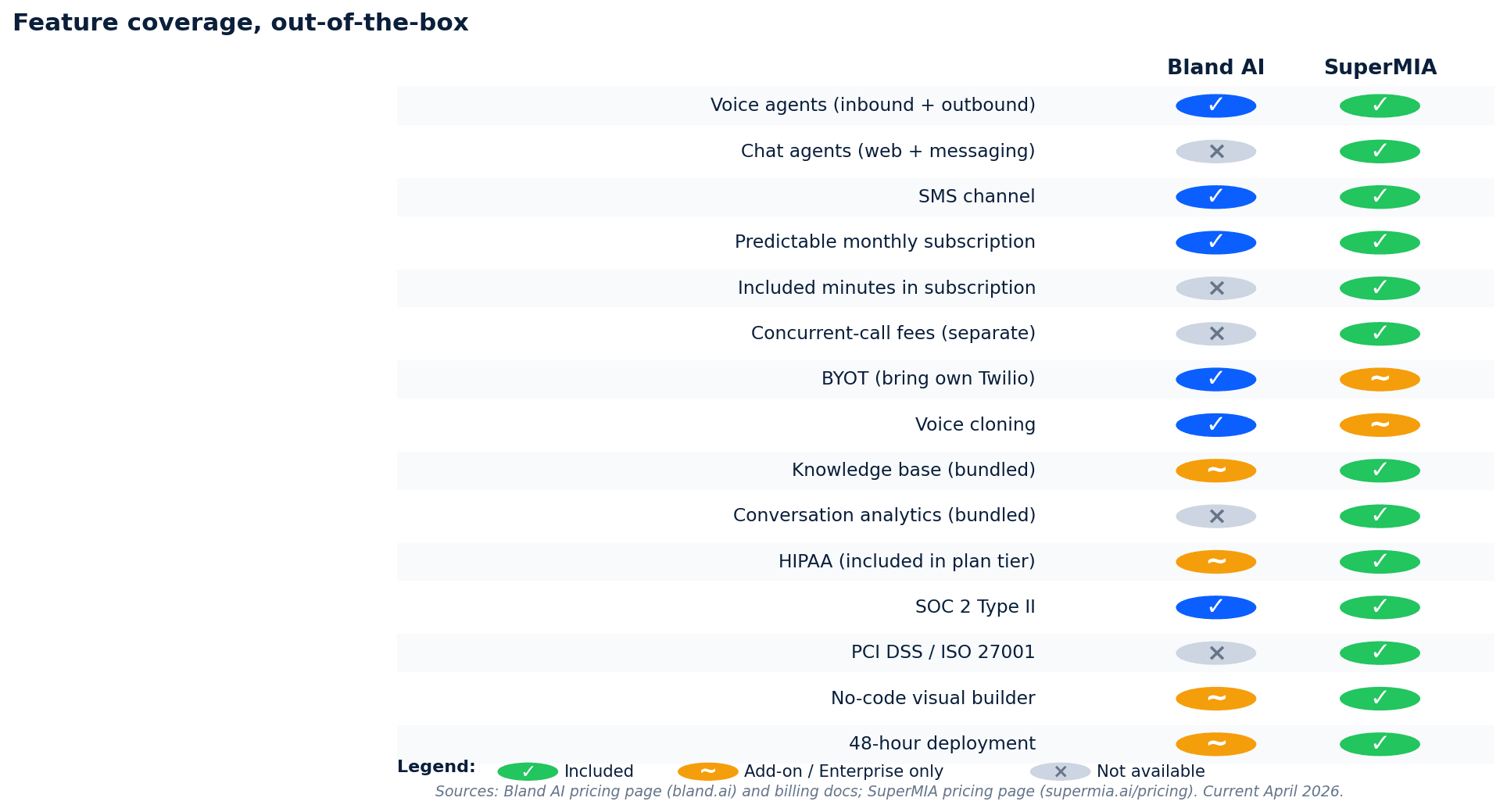
Bland generally wins on deep voice-specific developer controls. SuperMIA generally wins on breadth: voice + chat + compliance stack from one vendor and one billing model.
Head-to-head comparison
| Factor | Bland AI | SuperMIA |
|---|---|---|
| Primary buyer | Developer-heavy teams | Ops and growth teams |
| Pricing model | Subscription + usage | Credit-based bundled plans |
| Minutes included | No | Yes |
| Channels | Voice + SMS | Voice + chat + SMS |
| Telephony | Bland or BYOT | Bundled model |
| Voice cloning | Broad support | Enterprise-focused |
| Deployment style | Developer-led | Managed + no-code options |
| Compliance posture | SOC 2, HIPAA via enterprise BAA | SOC 2, HIPAA, PCI DSS, GDPR, ISO 27001 |
| Best-fit use case | High-scale voice-only | Unified voice + chat operations |
Who should pick Bland, and who should pick SuperMIA
Pick Bland AI if...
- You have a technical team and need deep voice flow control.
- Your workload is voice-first and high-volume.
- You want BYOT flexibility and can accept subscription-plus-usage billing.
Pick SuperMIA if...
- You need voice and chat agents under one billing pool.
- You are operating under 25K monthly minutes and want included capacity.
- You prefer bundled compliance and faster managed deployment.
One practical caveat: enterprise pricing is always negotiated. Above 50K minutes, pricing page math is directional only. Ask every vendor for commitment floors, overage behavior, and invoicing examples at your projected volume.
Frequently Asked Questions
The short version
Bland AI improved pricing predictability for voice teams compared with modular billing models. SuperMIA solves a different problem: unified voice-plus-chat operations with bundled compliance and included plan capacity.
Both platforms are valid choices. If your workload is voice-only and engineering-led at scale, Bland is often compelling. If you need unified channels, fast deployment, and cleaner small-to-mid volume economics, SuperMIA is usually the better fit.
Get custom SuperMIA pricing for your call volume →
Watch the companion breakdown: Bland AI pricing walkthrough on YouTube.

Harikrishna Patel
Harikrishna Patel is the founder of MIA – My Intelligent Assistant, the AI automation platform built under Botfinity Inc. in Dallas, Texas. With 15+ years in software engineering, AI/ML, and enterprise solution design, he focuses on creating practical, scalable AI tools that help businesses automate support, workflows, and operations through voice and chat.